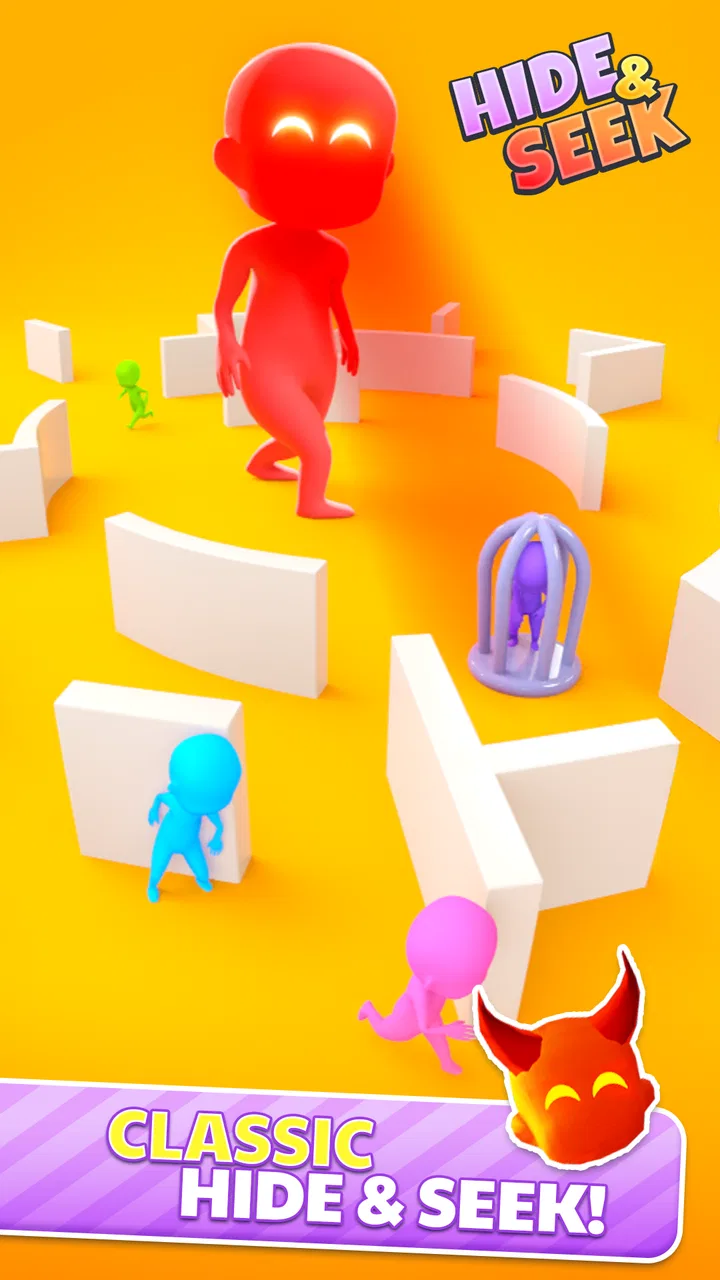
Hide 'N Seek!
- 4.2
- Rating
- 100.00M
- Installs
- Free
- Price

 Analysis by App-foxy
I expected a quick distraction from Hide 'N Seek, but its simple premise became more interesting once I paid attention to how each round changes the way I move. This is an action game from Supersonic Studios LTD built around a familiar childhood idea: one side hides while the other searches. The appeal is immediate because I understand the objective before the first match begins, yet the short rounds leave enough room for small decisions to matter.
It is free to play and suitable for Everyone, which makes it easy to try without turning the first session into a commitment. The game has also reached over 100 million installs, with an average rating of 4.2 from around 523 thousand ratings. Those numbers suggest broad appeal, but they do not answer the more useful question: does it remain enjoyable after the novelty wears off? My experience is that it can, although its lasting value depends heavily on whether you enjoy repeated, lightweight action rather than deep progression.
Why the first week feels so easy to enjoy
The strongest part of the opening experience is how quickly the game communicates its rhythm. I do not need a long tutorial or a detailed explanation of complicated systems. I enter a round, read the situation, and immediately start making choices about hiding, searching, moving, or waiting. That low barrier is ideal when I have only a few spare minutes and do not want to learn a large control scheme.
You May Also Like

 Blood Strike: 2.5 Anniversary
Blood Strike’s Loadouts Turn Every Drop Into a Tactical Gamble
A close look at Blood Strike’s custom loadouts: how fast access to signature weapons reshapes its battle royale rhythm, rewards preparation, and narrows the gap between fights.

 Pandora - Music & Podcasts
Pandora’s Music Is Easy to Start, but Harder to Recover
Pandora’s strength is its low-effort path from a seed to a station. Its weak spot is how much confidence it asks you to place in connection, setup, and quiet recovery.

 8 Ball Pool
 Is Built on Rivalries, Rematches, and Routine
A close look at the rivalries, rematches, shared routines, and unanswered safety questions that turn a quick pool match into a persistent mobile community.

 Samsung Music
’s Quiet Strength Is Playing What You Already Own
Its reach comes less from spectacle than from dependable access to a personal library. That simplicity is both the app’s strongest retention engine and its ceiling.

 AccuWeather: Weather Radar
AccuWeather Review: A Quick, Clear Forecast for Everyday Decisions
For everyday plans, the best forecast is the one you can understand quickly. AccuWeather makes rain timing, radar, and local conditions easy to act on, with a few trade-offs.

 Hill Climb Racing
Why Hill Climb Racing Still Turns Crashes Into One More Run
A tiny car, a bumpy hill and one more upgrade: Hill Climb Racing keeps resurfacing because its simple chaos makes every near-miss feel personal.
More From Our News Desk



As a hider, the interesting decision is not simply finding the nearest hiding place. I have to consider whether a location is too obvious, whether moving will expose me, and whether staying still is safer than trying to improve my position. As a seeker, the tension comes from reading the environment and checking likely spots without wasting time. These choices are modest, but they give the game more texture than its short description suggests.
The first few sessions are especially good for learning the visual language of the arenas. I began noticing which objects blend together, which paths are easy to overlook, and which areas attract attention because they look like natural hiding locations. That learning process creates a satisfying sense of improvement without requiring a formal lesson. I was not just reacting faster; I was becoming better at interpreting the space.
The game works well in an everyday situation where I have finished a task and want something active but undemanding. A couple of rounds can fill a short break, while a longer session gives me time to experiment with different approaches. I would not choose it for a quiet, story-driven evening, but it is a convenient option when I want immediate interaction without a large time investment.
Controls are approachable, which is important for a game aimed at a broad audience. Younger players can understand the basic goal, while adults can still enjoy the small psychological contest between hiding well and searching efficiently. The Everyone age rating supports that accessibility. I would still recommend that parents look at the in-app purchase settings on a shared device, especially if children are likely to play without supervision.
One useful early habit is to resist moving simply because the round feels quiet. New players often assume that constant movement is safer, but movement can also make a hiding strategy less effective. I found better results by treating each round as a choice between information and exposure: moving may reveal a better position, but remaining still preserves uncertainty for the seeker. That trade-off is one of the first signs that the game has more decision-making than its playful presentation implies.
What makes the central loop work
The hide-and-search structure creates natural reversals. A player who feels confident while hiding may become too comfortable and make a careless move. A seeker who searches quickly may overlook a less obvious location because they are focused on the most visible possibilities. I like that the game can turn on attention rather than only reflexes.
There is also a useful difference between playing safely and playing memorably. A cautious approach may help me survive longer, but taking a calculated risk can be more satisfying when I understand the layout. During my first week, I enjoyed switching between those styles instead of trying to find one perfect method. That variety is important because the basic objective remains the same from round to round.
Another small but meaningful tip is to avoid judging a hiding place only by how well it looks from one direction. A position that seems perfect when I arrive may become easy to spot once the searcher approaches from another angle. Thinking about the whole route, rather than the immediate appearance of a location, improved my decisions. This is the kind of practical lesson a store summary cannot communicate.
The developer, Supersonic Studios LTD, keeps the presentation focused on quick action rather than burying the main idea under menus. That helps the first week feel smooth. I can concentrate on the activity itself instead of spending the opening sessions managing a complicated account, studying extensive instructions, or preparing a long-term build.
Whether it earns attention after the novelty fades
The harder test begins after I already understand the basic pattern. A game can be excellent for a first afternoon and still have little reason to return. In this case, recurring value comes from the changing human decisions inside the same broad loop. I return when I want to sharpen my awareness, try a different hiding style, or see whether I can search more carefully than I did in the previous session.
That kind of value is real, but it is not the same as the long-term pull of a large competitive game. Players who need deep character development, elaborate strategy, a substantial narrative, or a constantly expanding set of systems may find the experience too light. The game is better understood as a repeatable arcade-style activity than as a major hobby that demands daily attention.
For month-to-month use, I think the best approach is to give each session a small purpose. I might focus on avoiding unnecessary movement, search less predictable areas, or deliberately change my usual route. Without a personal challenge, the rounds can blend together. With one, even a familiar arena becomes a place to test judgment.
This is also where the difference between casual and committed players becomes clear. A casual player can enjoy the immediate tension and stop whenever the mood passes. A more dedicated player may appreciate trying to become more efficient, but the game may not provide enough depth if that player expects a formal ladder, complex team coordination, or a broad competitive ecosystem. I would choose a more substantial action title for those needs.
The free entry point helps the game remain easy to revisit. I can install it without paying upfront, try the core experience, and decide whether it deserves space on my device. Optional purchases range from under a dollar to around twelve dollars per item. I would treat those purchases as convenience or customization decisions rather than part of the reason to begin playing. The important question is whether the basic loop already entertains you before spending anything.
My advice is to wait before buying anything. Play enough rounds to identify whether you enjoy the actual hiding and searching decisions, not just the first burst of surprise. If the game already feels repetitive during the opening sessions, a purchase is unlikely to solve that problem. On the other hand, if you keep returning because you enjoy improving your judgment, spending may feel more reasonable as a personal choice rather than an attempt to manufacture interest.
The maintenance effort is refreshingly small
One advantage of this format is that it does not demand much preparation. I do not need to remember a complicated build, maintain a large collection, or spend a long time getting ready before a match. That low maintenance makes it suitable for irregular players who may open the game only when they have a few minutes available.
The current version is 1.9.63 and requires Android 7.0 or later. For someone using an older device, checking compatibility before planning to play is sensible. On a supported phone, the practical burden is mostly personal: keeping the game installed, accepting that repeated sessions may feel familiar, and deciding whether optional purchases fit your habits.
That simplicity is a strength, but it also limits the sense of ownership. Games with extensive progression often give me a reason to return because I want to improve an account, unlock a new ability, or complete a longer objective. Here, the reason to come back is more immediate and self-directed. I play because the next round sounds fun, not because I have a large checklist waiting for me.
For families, that can be a benefit. The age rating of Everyone and the straightforward premise make it easier to explain than a more aggressive or complex action game. Still, free-to-play design deserves ordinary caution. If a child uses a payment-enabled device, I would review purchase controls before handing it over. The game is accessible, but accessibility should not be confused with automatic suitability for unsupervised spending.
Where fatigue starts to appear
The main source of fatigue is repetition. The central question remains whether I can hide effectively or find someone efficiently, and that question can lose force when I have played too many rounds in one sitting. I noticed that the game was most enjoyable when I stopped while the tension was still fresh instead of continuing until every match felt routine.
Another possible frustration is the gap between visual confidence and actual confidence. I may think I have found an excellent position, only to discover that the searcher’s route makes it obvious. Conversely, I may search an area thoroughly and still feel that I missed something simple. These moments can be entertaining when they feel like fair mistakes, but repeated uncertainty can become tiring for players who prefer precise feedback.
The short-session design does not automatically prevent repetition. In fact, quick rounds can make it easy to play several more than intended because starting another match requires little effort. I recommend setting a natural stopping point, especially during a break. The game is good at filling spare time, but it can also turn a short pause into a longer session without offering a major change of pace.
Players who dislike waiting, searching, or being caught may also struggle with the basic emotional rhythm. The most rewarding moments depend on suspense, and suspense includes periods where little seems to happen. Someone looking for constant action, rapid attacks, or a strong sense of mechanical mastery may prefer another action game. This one asks for patience and observation as much as quick reactions.
I also would not recommend it as the main game for someone seeking a deep social experience. The appeal is centered on the hide-and-seek contest itself, not on building a long narrative identity or managing a complex group strategy. A multiplayer title designed around communication would be a better choice for friends who want coordinated roles and extended teamwork.
How it compares with familiar alternatives
Compared with traditional arcade action games, this one is less about constant attacking and more about positioning, timing, and reading space. That makes it a gentler option for players who enjoy action but do not want an intense combat-focused experience. Compared with large competitive games, it is far easier to pick up, but it offers less strategic breadth and less reason to organize a regular team.
Compared with a conventional offline puzzle game, it feels more immediate and reactive. I am not solving a fixed problem with one correct answer; I am responding to an opponent’s behavior and adjusting as the round develops. The trade-off is that the experience may feel less satisfying when I want calm, predictable progress.
Compared with story-based mobile games, it has almost no need for a long attention span. I can enter and leave without worrying about forgetting a plot or losing track of a complicated objective. That makes it a practical companion for commutes, waiting rooms, or short breaks, provided I have the patience for repeated rounds and the device meets the Android requirement.
The most important comparison is not whether it has more content than another game, but whether its particular tension matches your taste. If you enjoy noticing patterns, taking small risks, and trying to outthink another player, it has a clear identity. If you need constant novelty, extensive unlocks, or a rich campaign, a different title will hold your attention longer.
My long-term verdict
After the initial novelty fades, I still see a place for Hide 'N Seek, but not as an all-purpose action game. Its lasting strength is convenience: the rules are easy to understand, the sessions can be short, and the hide-versus-search tension remains recognizable without a heavy maintenance burden. I can return after a gap and understand what I am doing immediately.
Its weakness is equally clear. The same focused loop that makes the game approachable can become repetitive when I play for too long or expect a deep progression system. Optional purchases do not change that basic judgment, so I would only consider them after deciding that the core rounds already provide enough value. The free price makes experimentation easy, but it does not remove the need to manage expectations.
I would recommend it to casual action players, families looking for a simple game with an Everyone rating, and anyone who wants a quick test of observation and timing. I would especially suggest it to people who enjoy setting their own small goals, such as searching more methodically or surviving without unnecessary movement. Those self-imposed challenges give the experience a better chance of staying interesting over time.
I would skip it if you want a story, complex combat, serious competitive structure, or a long-term collection to manage. I would also avoid marathon sessions if repetition quickly bothers you. The best way to use it is in measured bursts, returning when you genuinely want its particular kind of suspense rather than treating it like a game that must occupy every day.
My final view is positive but deliberately modest. Its lasting value comes from a dependable habit, not endless novelty. Supersonic Studios LTD has made an action game that is easy to start and easy to revisit, and its large install base reflects that accessibility. For me, it earns a small, useful space on a phone as a quick break game—not because it keeps expanding into something enormous, but because a well-timed round of hiding and searching still does exactly what I want.
FAQs for Hide 'N Seek!
01What is the primary objective of Hide 'N Seek! game?
Hide 'N Seek! is a casual mobile game where players alternate between hiding and seeking. The primary objective is to either find all hidden players within a set time if you’re the seeker or avoid being found if you’re hiding. The game combines strategy and quick thinking to offer an engaging experience.
02Is Hide 'N Seek! suitable for all age groups?
Yes, Hide 'N Seek! is designed to be family-friendly and suitable for all age groups. Its simple controls and intuitive gameplay make it accessible for younger players, while the strategic elements provide enough challenge to keep older players entertained. Parental guidance is recommended for very young children.
03Are there any in-app purchases in Hide 'N Seek!?
The game includes various in-app purchases that enhance the gaming experience. Players can buy additional skins, power-ups, and other cosmetic items. While these purchases can enhance gameplay, they are not necessary to progress in the game, allowing players to enjoy the full experience without spending money.
04Does Hide 'N Seek! require an internet connection to play?
Hide 'N Seek! can be played offline, making it perfect for on-the-go gaming. However, some features, such as leaderboards and certain multiplayer components, may require an internet connection. Playing online also ensures that you have access to the latest updates and features.
05How does multiplayer mode work in Hide 'N Seek!?
In multiplayer mode, Hide 'N Seek! allows you to play with friends or other online players. You can either join a random game or create a private room with your friends. The game supports seamless matchmaking, ensuring quick and exciting games without long wait times, enhancing the social aspect of the game.
Pros
- Engaging gameplay with simple controls.
- Colorful graphics appeal to all ages.
- Multiplayer mode enhances excitement.
- Regular updates with new features.
- Quick matches ideal for short play sessions.
Cons
- Ads can interrupt the gaming experience.
- Limited variety in hiding spots.
- In-app purchases can be expensive.
- Occasional connectivity issues.
- Sound effects can be repetitive.

Hide 'N Seek!
Gallery